I’m pretty good at editing, one of the few things I think I do well. I believe it’s a gift, but it can also be a curse. When I read a book, like it or not, I read it with an editorial eye, picking out every grammatical or punctuation error or poorly worded sentence. I sometimes even mark up the book with my corrections.
I get perturbed when I see poor English usage in books, magazines, newspapers, and television news programs because these writers are supposed to be experts. I’m also pleasantly surprised when they get it right – especially when it’s an inaccuracy that has gained traction. An example is the tendency for most people to use “I” as an object instead of “me.” When a newscaster says, for example, “Please join Pam and I tomorrow,” I’m disappointed but not surprised; however, when he says the correct “Please join Pam and me tomorrow,” I’m surprised and delighted. If people would just say the sentence to themselves without the other person’s name, they’d realize that they need to say “me” instead of “I” in these instances.
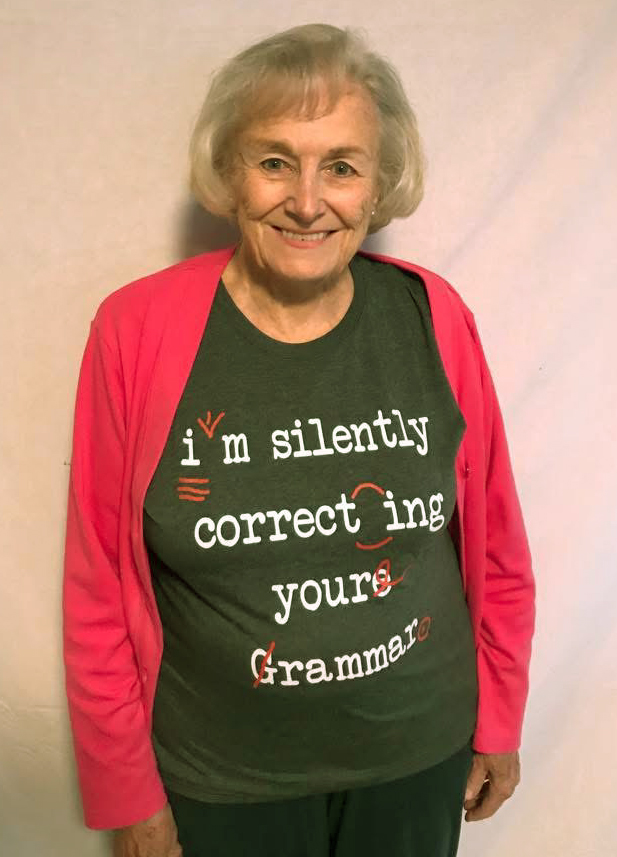
I have a friend who is a Speech Language Pathologist. She and I regularly communicate regarding things we read that irritate us. Usually, it’s misuse of a word. Every time I see a word or phrase that bothers me, I say to myself, “Oh boy, I’ll see what Chris has to say about that.” We’ve discussed many of the things that follow.
When I’m asked “Can I help you,” I feel like answering, “I don’t know; are you physically capable of helping me?” I should be asked instead “May I help you?” meaning “Do I have your permission to help you?” Then the salesperson might say “If you need me, I’ll be right over there.” Again, my smart aleck mind wants to say, “And if I don’t need you, where will you be?” I admit that these thoughts go a bit overboard, but I tell you to show how my obsessive editorializing mind works.
A thing can’t be “very unique” because “unique” means “one of a kind.” I also question “very excellent.”
I really believe that people are trying to sound scholarly when they say they are “feeling badly” rather than the correct “feeling bad.” The only way you can feel badly is if you’re feeling an object and your fingers aren’t working properly.
I don’t know whether I’m offended or just feel sorry for people who mispronounce words. First, I’m reminded of a friend who recently was telling me that she felt the same, stating that she becomes annoyed over the “mispronouncation” of words, not realizing that she herself was guilty of mispronouncing the word “mispronunciation.” One of the most common mispronounced words is “nuclear.” Another is “pundit,” with people saying “pundunt.” Then there are those who say “supposably” instead of “supposedly.” It reminds me of an episode of Friends, when Joey says “supposably” to himself several times, as though he’s testing it. When he finally decides that his pronunciation is correct, the look of satisfaction on his face is priceless. Although a man may be prostrate when he has an examination, it’s not his prostrate that’s checked, it’s his prostate. A point that is not relevant is a moot point – not a mute point, which I guess would be a quiet point. The word “zoology” is pronounced “zo-ology”; in order to be “zoo-ology,” there would need to be four “o’s.” Speaking of “o’s,” although it’s incorrect to say “o” instead of “zero,” I think people can be forgiven for making the substitution in the interest of brevity.
The tendency these days seems to be that the phrase “you’re welcome” is non-existent. When you thank someone, the response will usually be “no problem.” Whew! What a relief to know that I haven’t created a problem. When I thanked my great granddaughter the other day, she replied, “Of course.” Instead of being annoyed that she hadn’t used the obligatory “you’re welcome,” I thought it was kind of sweet – I don’t know whether it was because it really was sweet or because my great granddaughter is sweet. I was reading that when Chick-fil-A employees are being trained, they’re taught to say “my pleasure” instead of “you’re welcome.” I certainly find “no problem” with that response.
Eliminating the phrase “Thank you” isn’t the only etiquette breach that bothers me. Another one has to do with the way married couples’ names are signed. This isn’t a new mistake, though. It’s taken place for as long as I can remember. My theory is that after a couple marries, the wife, usually the one responsible for corresponding, says to herself, “My husband is more important than I, so his name should come first.” Consequently, she would sign letters and cards with his name first, e.g. “John and Mary Smith.” How often have you received a communication signed with the husband’s name first, even though you may never have met him? I say to myself “How nice of John to send me a note when I don’t even know him. Oh, I see Mary’s name appears as well.” Etiquette dictates that because the couple’s last name has always been the husband’s last name, it should appear directly after his first name; hence “Mary and John Smith.” Of course, this doesn’t take into consideration women who don’t adopt their husbands’ surnames. I admit that only a handful of people actually know about this etiquette rule.
Have you ever heard someone say that he or she is anxious to do something pleasant, e.g., “I’m anxious to go to Disneyland”? Because “anxious” means “fearfully awaiting,” that would suggest that the person is expressing fear at the Disneyland prospect, which probably isn’t so – unless perhaps scary roller coasters are involved. Actually, the person is eager: ”I’m anxious about the upcoming weather because I’m eager to go to Disneyland.”
I’d like to discuss placement of the word “only.” Many tend to put the word in the wrong place. An example would be “I only have one dollar,” which would suggest that the only possession I have is a dollar. If I’m talking about the amount of money I have, what should have been said is “I have only one dollar.” Another example would be “I only delivered three packages.” That suggests that delivering three packages is the only thing I did. “I delivered only three packages” conveys the intended meaning.
Recently I said to my daughter, “I haven’t drunk my milk yet,” which got me thinking that many people would say instead “I haven’t drank my milk yet,” probably because they don’t want to be associated with the word “drunk.” Seriously, because of the word “haven’t,” the past participle “drunk” should be used instead of the past tense “drank.” Many have problems with verb tenses: present, past, and past participle. Think “drink, drank, drunk; bring, brang, brung” – just kidding. It’s, of course, “bring, brought, brought.” Verb tenses can be tricky, but there’s no need to learn the terms. Just say to yourself: “Today I drink, yesterday I drank, I have drunk,” and “Today I bring, yesterday I brought, I have brought.”
When being trained, it seems that the number one rule taught to medical receptionists, salespeople, and wait staffs is to be sure to use the word “perfect” as many times as they can. “What is your zip code?” “97495.” “Perfect.” “Does your phone number end in 3977?” “Yes.” “Perfect.” “Did you get everything you needed today?” “Yes.” “Perfect.” “Would you like fries with that?” “No, thank you,” “Perfect.” Instead of being annoyed, I guess I should be thrilled to be so perfect. Oh, I forgot to mention, the pronunciation is usually “PURRR-fect.”
Speaking about wait staffs, some people get extremely irritated to be considered guys – “What can I get you guys?” I don’t mind it too much, probably because at my age it’s nice to be given a name usually reserved for young people.
My husband officiated basketball games. I recall that he would call flagrant fouls, meaning fouls that needn’t have been committed. That’s the way I feel about the use of the words “they/them,” and “him/her.” Grammar aside, in my opinion, some of the errors made are mathematically incorrect. I read in an advice column “Discuss this with an attorney and enlist their help.” I think that “their” shouldn’t refer to one attorney. If the advice had been “Discuss this with attorneys and enlist their help,” that would have been mathematically correct, in my opinion. When I was in school, the proper format would be “Discuss this with an attorney and enlist his or her help.” In today’s climate, “his or her” can’t be used because it doesn’t include the people who claim to be neither. “They” has a completely different meaning, sometimes being the preferred pronoun. There are so many pronouns floating around today that I guess writers solve the problem by using only they/their. I have even seen examples so flagrant that people use “their” when they know whether it refers to a male or female. I read “My son had to return to school to get their backpack.” You know your son is a boy, so why not say “ . . . to get his backpack”? Here’s another flagrant example. A woman wrote to an advice column that her husband was dragging his feet regarding legal matters. The response read “If your spouse refuses to make arrangements for their possessions and directives concerning their health and demise, you may not be able to change their minds.” So, in addition to using “their” instead of “his” when talking about a husband, the columnist got so carried away with all of the “theirs” that she forgot she was dealing with one husband and she made “minds” plural. I realize that the time has come when I need to accept wrong pronoun usages, but I reserve the right to grit my teeth while doing it.
It bothers me when I read about 2,000 troops being sent to a city, not only because it’s stupid to send soldiers or National Guard personnel to cities where they’re not wanted or needed, but because I don’t like using the word “troop” to mean one person. My son belonged to a Boy Scout troop and my daughters belonged to Girl Scout troops. Each of them wasn’t a troop. I looked up the word “troop,” and the definition is “a group of soldiers.”
When I don’t feel well, I may take my temperature by using a thermometer. Invariably, someone will ask “Do you have a temperature?” Of course I have a temperature. I always do. What you mean to ask is whether I have a fever. Everyone always has a temperature – well, maybe dead people don’t, but come to think of it, I guess even they do.
Let’s talk about the word “like.” I’m sure you’ve like noticed the number of times a young person like uses the word as a verbal placeholder, often like several times in one sentence. It’s annoying, but we’ve come to accept it. We old folks even find ourselves saying it. Another misuse of the word “like” is to say “is like” or “was like” instead of saying “said”: “I was like ‘Let’s go,’ and he was like ‘I’m not ready’.” This is suggested to have originated with “Valley Girl” slang, the idea being that the speaker is acting out what was said. In other words, “this is what she was like when making her statement.” That’s a pretty far-fetched explanation for this strange speech pattern which cannot ever be justified grammatically. Regarding legitimate uses of the word “like,” because I’m old school, I use “like” to compare things, but not to give examples. “A cucumber is like a zucchini in shape” shows comparison. When giving examples, some people would say “She grew several vegetables, like cucumbers.” I would say “She grew several vegetables, “such as” cucumbers” or “including” cucumbers.” To me, using “like” in this case suggests that the vegetables she grew are similar to cucumbers, when the person actually means that cucumbers are among the vegetables she grew. Because of current usage, I’ve come to accept other people saying “like” in this case, but I personally say “such as” or “including,” which I consider more accurate.
People may be proud of themselves when they use the word “whom” instead of “who.” Many believe that if it comes in the middle of a sentence, it will be “whom.” This isn’t always the case. If the word is a subject instead of an object, no matter the location in the sentence, “who” is used. An example is: “She is the one who carries the flag.” In this case, “who” is the subject of the object “flag.” When saying “The person whom I met carries the flag,” “I” is the subject and “whom” the object. In this case, the object in the sentence precedes the subject.
Recently, I’ve noticed that television actors will begin a sentence with “yeah, no,” which makes no sense. When I first pointed this out to my daughter Michelle, she wasn’t aware of the trend, but after I told her about it, she began to notice. Now, while watching TV, Michelle and I have fun shouting out “Yeah, no” every time an actor uses this nonsensical statement. You may not remember hearing this expression, but now that I’ve told you, be ready for it and you’ll be surprised how often you hear it. Another sentence starter is “I mean,” which should indicate that an explanation of what I just said is forthcoming. If you haven’t yet said anything, what are you clarifying? When I watch America’s Got Talent, I’m always surprised when Heidi Klum doesn’t begin a sentence with “I mean.”
There’s a bit of dialogue that I’ve seen in shows that I believe defies logic. Someone will say “I think” such-and-such, and the person being spoken to will ask “Are you sure?” The logical answer would be “No I’m not sure – that’s why I said I think such-and-such”; however, that’s not the usual answer. Instead, when asked “Are you sure?” the person will answer affirmatively and go on to explain why he or she is sure. Again, if you never noticed this speech pattern, be aware when someone utters “I think . . .” and someone else asks “Are you sure?”
For some reason that I can’t understand, the word “good” has become verboten. Instead, people substitute the word “well.” When asked “How are you,” the response will probably be “I’m well, thank you,” which is a fine answer if the person is inquiring about your health. However, if the person is asking about your general well-being, the answer should be “I’m good, thank you,” which for generations was the response given. I have no idea why the word “good” grew out of favor. Some people have really gone overboard using “well” instead of “good.” Following are examples of instances when “well” was used erroneously when the word should have been “good.” During the CBS show Sunday Morning, an interviewer asked “So it’s very well to say . . .” In a scene from a period movie, while looking at a pair of shoes in a shop window, Maggie Smith said to a young lady, “I think those blue shoes would look very well on you.” Later, in speaking about a young man, she said, “He is very well to look at – very well indeed.” You’d think that the writer was forbidden to use the word “good.”
Speaking of the word “forbidden,” I don’t like it when people say “forbidden from,” instead of “forbidden to.” Rather than say “You are forbidden from going to the mall,” I prefer “You are forbidden to go to the mall.” This is another case of both being acceptable. I can’t give the rule, but “forbidden from” sounds wrong to me.
I believe it’s time to invent a new word for grown offspring. I think “children” should refer only to individuals under 18 years old. When I fill out forms in a doctor’s office, in the section about emergency contact, where it says “Relationship to patient,” one option is “child.” I always say to myself “Wait a minute – Michelle’s not a child.”
I’d like to talk about redundancy – using two words that mean the same. Some examples are “tiny little candle,” “final conclusion,” and “merge together.” “Tiny” and “little” mean the same, as is the case with “final” and “conclusion,” and “merge” and “together.” Choose one word or the other, but not both. Then there are times when an unnecessary word is added. One that really bothers me, which we see everywhere, is “for free,” which should be just “free.” “Buy two mustache combs and get a nose-hair trimmer for free.” I believe you get the nose-hair trimmer free. When I researched this, I found “for free” to be slang, but, of course, acceptable. This is no surprise because the ongoing theme when discussing grammar seems to be that common usage makes just about anything “acceptable.”
Then there are times when a person speaking will eliminate essential letters, saying “most anybody,” and “most all,” for example, when they should say “almost anybody” and “almost all.” I believe it’s a regional thing. I really loved Jack Smith’s column in the LA Times, which ran for 37 years. I often sent letters to Jack, and he was kind enough to answer. Once he devoted an entire column to a letter that I wrote to him. At another time, after he used the term “most anything,” I wrote a note to him suggesting that this was poor form. He responded that he was sorry and would try to do better. He added “I guess I learned it at my mother’s knee.”
Young people tend to say “on accident” instead of “by accident,” which sounds peculiar to me. They certainly wouldn’t say “on design” rather than “by design.”
Do you feel good about yourself when you eat healthy food? I prefer healthful food, i.e., food that will cause me to be healthy. On the other hand, I guess it’s nice to know that I’m eating healthy food because if the food itself is in good health, it would probably do a better job of being healthful to me. Again (sigh) the term “healthy food,” is acceptable, although wrong in my opinion.
Sometimes, rather than sound highfalutin, I’ll deliberately use poor grammar. Linking verbs – is and was – are followed by nominative rather than objective nouns. Therefore, it’s correct. to say “It is I,” but I just may decide to be a maverick and say “It’s me.” I love to say “You done good,” just because it’s fun! There are other times when I deliberately break the rules. For example, I often use the word “ain’t,” knowing full well that it’s wrong, but deciding it fits the mood. I’m dismayed when someone asks “Where are you at?” or even, heaven forbid, “Where you at?” Even so, I sometimes say it in jest. Needless to say, the word “at” is superfluous.
One of the most widely made grammatical errors is the incorrect usage of the word “lay” when what is meant is “lie.” You can lay something down, but you yourself lie down. After much cajoling from me, my family members have adopted the habit of using “lie” when appropriate, and they and I are definitely in the minority when we tell our dog to “lie down.”
Following is part of an email on the subject of lie/lay that I sent to Dr. Roach, whose column runs in the online newspaper I read daily:
“I’m on a quest to get people, medical professionals particularly, to learn to say ‘lie’ instead of ‘lay.’ The reason for the emphasis on medical personnel is that one thing they say often to patients is ‘lay down.’ It should be ‘lie down.’ I’m always so pleased when a nurse tells me to lie down that I feel like applauding. In your answer to B.Y., you said ‘The fact that it only occurs when you’re laying down . . .’ Admittedly, B.Y. made the error first, but B.Y. isn’t writing a newspaper column. I won’t go into the reason for using ‘lie’ instead of ‘lay,’ as you can research that on your own, but I will agree that grammar can be tricky — the fact that the past tense of “lie” is “lay” doesn’t help matters.”
That was my letter to the doctor. Once before, I’d written to Dr. Roach on some other subject, telling him that this wasn’t a letter to be published in his column, but a suggestion. He was nice enough to respond, thanking me and telling me that he’d take my advice. He didn’t respond to this new letter, but several days later, the following was a part of his column; “when a person is lying down. . .” I think he got the message.
When people finally learn to say lie,” invariably, they’ll think that the past tense is “lied,” but – as mentioned previously – it’s “lay.” Just remember: today I lie down – yesterday I lay down; today I lay something down – yesterday I laid something down.
In a medical show I was watching, a doctor asked a patient to lay down. Not surprising. Later, this same doctor asked the same patient to lie down. One out of two – pretty good. Later she said to the patient “I’m going to lie you down.” (Head slap). The doctor was placing (“laying”) the patient down. Oh well, can’t win them all.
If a poll were taken, I think it would be found that most people say “lay” when it should be “lie.” I’m optimistic enough to believe that references will not call the former “acceptable.”
I always believed, and still do, that “between” is used when talking about two things and “among” is used for more. “Choose between apples and oranges,” and “Choose among apples, oranges, and pears.” If you Google it, though, you’ll be told that “between” can be used when discussing more than two items. The example given was “This is between you, me, and the bedpost,” a colloquialism, for heaven’s sake! The same holds true for “better” and “best.” When I went to school, “better” was used for two and “best” for three or more. When I researched it, I found “using ‘best’ for two is common and understood.” So that’s the criteria now. We are living in an era of what I call “lax language,” which I attribute to laziness – as long as it’s understood, the hell with rules of grammar. Nevertheless, I’m adamant about some rules that I believe shouldn’t be bent. I was reading that double negatives are now acceptable because of the Rolling Stones song, I Can’t Get No Satisfaction. Really? We’re going to base our grammatical rules on a bunch of aging rock musicians?
I found a hopeful sign in all this bad grammar. Usually when a misuse is labeled “acceptable,” there’s the caveat that it doesn’t hold true for formal writing. It’s good to know that we purists can still find reading materials that are grammatically correct.
Obviously, I’m frustrated by the lax language prevalent today, with obvious incorrect grammar being “acceptable.” but I won’t shed no tears. No, I’ll just go lay down.

