Uncategorized

I Have This Thing About Grammar

I’m pretty good at editing, one of the few things I think I do well.  I believe it’s a gift, but it can also be a curse. When I read a book, like it or not, I read it with an editorial eye, picking out every grammatical or punctuation error or poorly worded sentence.  I sometimes even mark up the book with my corrections.

I get perturbed when I see poor English usage in books, magazines, newspapers, and television news programs because these writers are supposed to be experts.  I’m also pleasantly surprised when they get it right – especially when it’s an inaccuracy that has gained traction. An example is the tendency for most people to use “I” as an object instead of “me.” When a newscaster says, for example, “Please join Pam and I tomorrow,” I’m disappointed but not surprised; however, when he says the correct “Please join Pam and me tomorrow,” I’m surprised and delighted. If people would just say the sentence to themselves without the other person’s name, they’d realize that they need to say “me” instead of “I” in these instances.
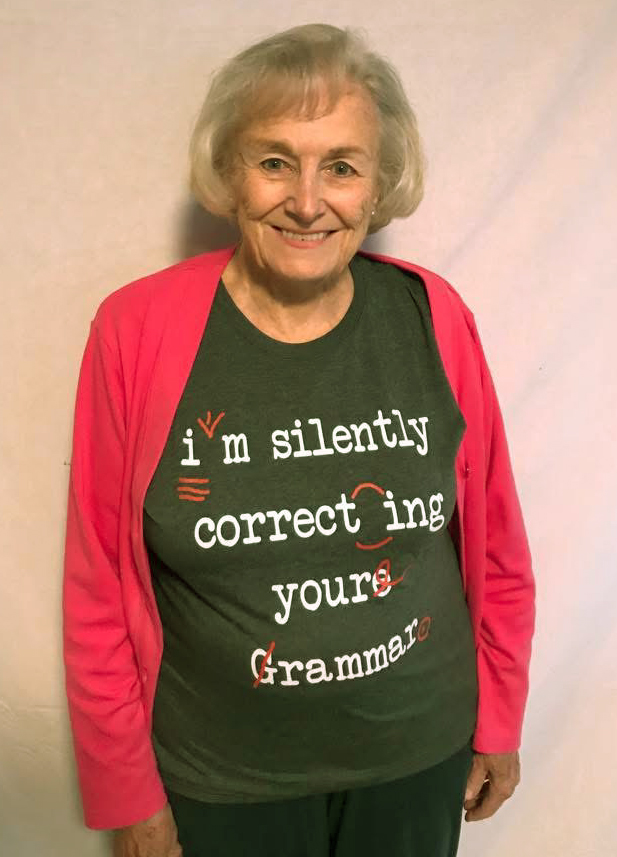
I have a friend who is a Speech Language Pathologist.  She and I regularly communicate regarding things we read that irritate us.  Usually, it’s misuse of a word.  Every time I see a word or phrase that bothers me, I say to myself, “Oh boy, I’ll see what Chris has to say about that.” We’ve discussed many of the things that follow. 

When I’m asked “Can I help you,” I feel like answering, “I don’t know; are you physically capable of helping me?” I should be asked instead “May I help you?” meaning “Do I have your permission to help you?”  Then the salesperson might say “If you need me, I’ll be right over there.”  Again, my smart aleck mind wants to say, “And if I don’t need you, where will you be?” I admit that these thoughts go a bit overboard, but I tell you to show how my obsessive editorializing mind works.

A thing can’t be “very unique” because “unique” means “one of a kind.” I also question “very excellent.”

I really believe that people are trying to sound scholarly when they say they are “feeling badly” rather than the correct “feeling bad.” The only way you can feel badly is if you’re feeling an object and your fingers aren’t working properly.

I don’t know whether I’m offended or just feel sorry for people who mispronounce words.  First, I’m reminded of a friend who recently was telling me that she felt the same, stating that she becomes annoyed over the “mispronouncation” of words, not realizing that she herself was guilty of mispronouncing the word “mispronunciation.”  One of the most common mispronounced words is “nuclear.” Another is “pundit,” with people saying “pundunt.” Then there are those who say “supposably” instead of “supposedly.” It reminds me of an episode of Friends, when Joey says “supposably” to himself several times, as though he’s testing it. When he finally decides that his pronunciation is correct, the look of satisfaction on his face is priceless. Although a man may be prostrate when he has an examination, it’s not his prostrate that’s checked, it’s his prostate. A point that is not relevant is a moot point – not a mute point, which I guess would be a quiet point. The word “zoology” is pronounced “zo-ology”; in order to be “zoo-ology,” there would need to be four “o’s.” Speaking of “o’s,” although it’s incorrect to say “o” instead of “zero,” I think people can be forgiven for making the substitution in the interest of brevity. 

The tendency these days seems to be that the phrase “you’re welcome” is non-existent.  When you thank someone, the response will usually be “no problem.” Whew! What a relief to know that I haven’t created a problem. When I thanked my great granddaughter the other day, she replied, “Of course.” Instead of being annoyed that she hadn’t used the obligatory “you’re welcome,” I thought it was kind of sweet – I don’t know whether it was because it really was sweet or because my great granddaughter is sweet. I was reading that when Chick-fil-A employees are being trained, they’re taught to say “my pleasure” instead of “you’re welcome.” I certainly find “no problem” with that response.

Eliminating the phrase “Thank you” isn’t the only etiquette breach that bothers me.  Another one has to do with the way married couples’ names are signed. This isn’t a new mistake, though.  It’s taken place for as long as I can remember.  My theory is that after a couple marries, the wife, usually the one responsible for corresponding, says to herself, “My husband is more important than I, so his name should come first.”  Consequently, she would sign letters and cards with his name first, e.g. “John and Mary Smith.” How often have you received a communication signed with the husband’s name first, even though you may never have met him? I say to myself “How nice of John to send me a note when I don’t even know him. Oh, I see Mary’s name appears as well.” Etiquette dictates that because the couple’s last name has always been the husband’s last name, it should appear directly after his first name; hence “Mary and John Smith.” Of course, this doesn’t take into consideration women who don’t adopt their husbands’ surnames. I admit that only a handful of people actually know about this etiquette rule. 

Have you ever heard someone say that he or she is anxious to do something pleasant, e.g., “I’m anxious to go to Disneyland”?  Because “anxious” means “fearfully awaiting,” that would suggest that the person is expressing fear at the Disneyland prospect, which probably isn’t so – unless perhaps scary roller coasters are involved. Actually, the person is eager: ”I’m anxious about the upcoming weather because I’m eager to go to Disneyland.”

I’d like to discuss placement of the word “only.”  Many tend to put the word in the wrong place. An example would be “I only have one dollar,” which would suggest that the only possession I have is a dollar.  If I’m talking about the amount of money I have, what should have been said is “I have only one dollar.” Another example would be “I only delivered three packages.” That suggests that delivering three packages is the only thing I did. “I delivered only three packages” conveys the intended meaning.

Recently I said to my daughter, “I haven’t drunk my milk yet,” which got me thinking that many people would say instead “I haven’t drank my milk yet,” probably because they don’t want to be associated with the word “drunk.” Seriously, because of the word “haven’t,” the past participle “drunk” should be used instead of the past tense “drank.”  Many have problems with verb tenses: present, past, and past participle. Think “drink, drank, drunk; bring, brang, brung” – just kidding. It’s, of course, “bring, brought, brought.” Verb tenses can be tricky, but there’s no need to learn the terms. Just say to yourself: “Today I drink, yesterday I drank, I have drunk,” and “Today I bring, yesterday I brought, I have brought.”

When being trained, it seems that the number one rule taught to medical receptionists, salespeople, and wait staffs is to be sure to use the word “perfect” as many times as they can. “What is your zip code?” “97495.” “Perfect.” “Does your phone number end in 3977?” “Yes.” “Perfect.” “Did you get everything you needed today?” “Yes.” “Perfect.” “Would you like fries with that?” “No, thank you,” “Perfect.” Instead of being annoyed, I guess I should be thrilled to be so perfect. Oh, I forgot to mention, the pronunciation is usually “PURRR-fect.”

Speaking about wait staffs, some people get extremely irritated to be considered guys – “What can I get you guys?” I don’t mind it too much, probably because at my age it’s nice to be given a name usually reserved for young people. 

My husband officiated basketball games. I recall that he would call flagrant fouls, meaning fouls that needn’t have been committed.  That’s the way I feel about the use of the words “they/them,” and “him/her.” Grammar aside, in my opinion, some of the errors made are mathematically incorrect.  I read in an advice column “Discuss this with an attorney and enlist their help.” I think that “their” shouldn’t refer to one attorney.  If the advice had been “Discuss this with attorneys and enlist their help,” that would have been mathematically correct, in my opinion. When I was in school, the proper format would be “Discuss this with an attorney and enlist his or her help.” In today’s climate, “his or her” can’t be used because it doesn’t include the people who claim to be neither. “They” has a completely different meaning, sometimes being the preferred pronoun. There are so many pronouns floating around today that I guess writers solve the problem by using only they/their. I have even seen examples so flagrant that people use “their” when they know whether it refers to a male or female.  I read “My son had to return to school to get their backpack.” You know your son is a boy, so why not say “ . . . to get his backpack”?  Here’s another flagrant example. A woman wrote to an advice column that her husband was dragging his feet regarding legal matters.  The response read “If your spouse refuses to make arrangements for their possessions and directives concerning their health and demise, you may not be able to change their minds.” So, in addition to using “their” instead of “his” when talking about a husband, the columnist got so carried away with all of the “theirs” that she forgot she was dealing with one husband and she made “minds” plural. I realize that the time has come when I need to accept wrong pronoun usages, but I reserve the right to grit my teeth while doing it.

It bothers me when I read about 2,000 troops being sent to a city, not only because it’s stupid to send soldiers or National Guard personnel to cities where they’re not wanted or needed, but because I don’t like using the word “troop” to mean one person.  My son belonged to a Boy Scout troop and my daughters belonged to Girl Scout troops. Each of them wasn’t a troop. I looked up the word “troop,” and the definition is “a group of soldiers.”

When I don’t feel well, I may take my temperature by using a thermometer.  Invariably, someone will ask “Do you have a temperature?” Of course I have a temperature. I always do. What you mean to ask is whether I have a fever. Everyone always has a temperature – well, maybe dead people don’t, but come to think of it, I guess even they do.

Let’s talk about the word “like.”  I’m sure you’ve like noticed the number of times a young person like uses the word as a verbal placeholder, often like several times in one sentence.  It’s annoying, but we’ve come to accept it. We old folks even find ourselves saying it. Another misuse of the word “like” is to say “is like” or “was like” instead of saying “said”: “I was like ‘Let’s go,’ and he was like ‘I’m not ready’.” This is suggested to have originated with “Valley Girl” slang, the idea being that the speaker is acting out what was said. In other words, “this is what she was like when making her statement.” That’s a pretty far-fetched explanation for this strange speech pattern which cannot ever be justified grammatically. Regarding legitimate uses of the word “like,” because I’m old school, I use “like” to compare things, but not to give examples. “A cucumber is like a zucchini in shape” shows comparison. When giving examples, some people would say “She grew several vegetables, like cucumbers.” I would say “She grew several vegetables, “such as” cucumbers” or “including” cucumbers.” To me, using “like” in this case suggests that the vegetables she grew are similar to cucumbers, when the person actually means that cucumbers are among the vegetables she grew.  Because of current usage, I’ve come to accept other people saying “like” in this case, but I personally say “such as” or “including,” which I consider more accurate. 

People may be proud of themselves when they use the word “whom” instead of “who.”  Many believe that if it comes in the middle of a sentence, it will be “whom.”  This isn’t always the case.  If the word is a subject instead of an object, no matter the location in the sentence, “who” is used.  An example is: “She is the one who carries the flag.” In this case, “who” is the subject of the object “flag.” When saying “The person whom I met carries the flag,” “I” is the subject and “whom” the object. In this case, the object in the sentence precedes the subject.

Recently, I’ve noticed that television actors will begin a sentence with “yeah, no,” which makes no sense. When I first pointed this out to my daughter Michelle, she wasn’t aware of the trend, but after I told her about it, she began to notice. Now, while watching TV, Michelle and I have fun shouting out “Yeah, no” every time an actor uses this nonsensical statement. You may not remember hearing this expression, but now that I’ve told you, be ready for it and you’ll be surprised how often you hear it. Another sentence starter is “I mean,” which should indicate that an explanation of what I just said is forthcoming.  If you haven’t yet said anything, what are you clarifying?  When I watch America’s Got Talent, I’m always surprised when Heidi Klum doesn’t begin a sentence with “I mean.”

There’s a bit of dialogue that I’ve seen in shows that I believe defies logic. Someone will say “I think” such-and-such, and the person being spoken to will ask “Are you sure?” The logical answer would be “No I’m not sure – that’s why I said I think such-and-such”; however, that’s not the usual answer. Instead, when asked “Are you sure?” the person will answer affirmatively and go on to explain why he or she is sure. Again, if you never noticed this speech pattern, be aware when someone utters “I think . . .” and someone else asks “Are you sure?” 

For some reason that I can’t understand, the word “good” has become verboten.  Instead, people substitute the word “well.”  When asked “How are you,” the response will probably be “I’m well, thank you,” which is a fine answer if the person is inquiring about your health. However, if the person is asking about your general well-being, the answer should be “I’m good, thank you,” which for generations was the response given.  I have no idea why the word “good” grew out of favor. Some people have really gone overboard using “well” instead of “good.”  Following are examples of instances when “well” was used erroneously when the word should have been “good.” During the CBS show Sunday Morning, an interviewer asked “So it’s very well to say . . .” In a scene from a period movie, while looking at a pair of shoes in a shop window, Maggie Smith said to a young lady, “I think those blue shoes would look very well on you.” Later, in speaking about a young man, she said, “He is very well to look at – very well indeed.” You’d think that the writer was forbidden to use the word “good.” 

Speaking of the word “forbidden,” I don’t like it when people say “forbidden from,” instead of “forbidden to.” Rather than say “You are forbidden from going to the mall,” I prefer “You are forbidden to go to the mall.” This is another case of both being acceptable. I can’t give the rule, but “forbidden from” sounds wrong to me. 

I believe it’s time to invent a new word for grown offspring.  I think “children” should refer only to individuals under 18 years old.  When I fill out forms in a doctor’s office, in the section about emergency contact, where it says “Relationship to patient,” one option is “child.” I always say to myself “Wait a minute – Michelle’s not a child.” 

I’d like to talk about redundancy – using two words that mean the same. Some examples are “tiny little candle,” “final conclusion,” and “merge together.”  “Tiny” and “little” mean the same, as is the case with “final” and “conclusion,” and “merge” and “together.” Choose one word or the other, but not both. Then there are times when an unnecessary word is added. One that really bothers me, which we see everywhere, is “for free,” which should be just “free.” “Buy two mustache combs and get a nose-hair trimmer for free.” I believe you get the nose-hair trimmer free. When I researched this, I found “for free” to be slang, but, of course, acceptable. This is no surprise because the ongoing theme when discussing grammar seems to be that common usage makes just about anything “acceptable.” 

Then there are times when a person speaking will eliminate essential letters, saying “most anybody,” and “most all,” for example, when they should say “almost anybody” and “almost all.” I believe it’s a regional thing. I really loved Jack Smith’s column in the LA Times, which ran for 37 years. I often sent letters to Jack, and he was kind enough to answer. Once he devoted an entire column to a letter that I wrote to him. At another time, after he used the term “most anything,” I wrote a note to him suggesting that this was poor form. He responded that he was sorry and would try to do better. He added “I guess I learned it at my mother’s knee.”

Young people tend to say “on accident” instead of “by accident,” which sounds peculiar to me. They certainly wouldn’t say “on design” rather than “by design.”

Do you feel good about yourself when you eat healthy food? I prefer healthful food, i.e., food that will cause me to be healthy. On the other hand, I guess it’s nice to know that I’m eating healthy food because if the food itself is in good health, it would probably do a better job of being healthful to me. Again (sigh) the term “healthy food,” is acceptable, although wrong in my opinion.

Sometimes, rather than sound highfalutin, I’ll deliberately use poor grammar. Linking verbs – is and was – are followed by nominative rather than objective nouns.  Therefore, it’s correct. to say “It is I,” but I just may decide to be a maverick and say “It’s me.” I love to say “You done good,” just because it’s fun! There are other times when I deliberately break the rules.  For example, I often use the word “ain’t,” knowing full well that it’s wrong, but deciding it fits the mood. I’m dismayed when someone asks “Where are you at?” or even, heaven forbid, “Where you at?” Even so, I sometimes say it in jest. Needless to say, the word “at” is superfluous. 

One of the most widely made grammatical errors is the incorrect usage of the word “lay” when what is meant is “lie.”  You can lay something down, but you yourself lie down. After much cajoling from me, my family members have adopted the habit of using “lie” when appropriate, and they and I are definitely in the minority when we tell our dog to “lie down.” 

Following is part of an email on the subject of lie/lay that I sent to Dr. Roach, whose column runs in the online newspaper I read daily:

“I’m on a quest to get people, medical professionals particularly, to learn to say ‘lie’ instead of ‘lay.’  The reason for the emphasis on medical personnel is that one thing they say often to patients is ‘lay down.’  It should be ‘lie down.’ I’m always so pleased when a nurse tells me to lie down that I feel like applauding. In your answer to B.Y., you said ‘The fact that it only occurs when you’re laying down . . .’  Admittedly, B.Y. made the error first, but B.Y. isn’t writing a newspaper column. I won’t go into the reason for using ‘lie’ instead of ‘lay,’ as you can research that on your own, but I will agree that grammar can be tricky — the fact that the past tense of “lie” is “lay” doesn’t help matters.” 

That was my letter to the doctor.  Once before, I’d written to Dr. Roach on some other subject, telling him that this wasn’t a letter to be published in his column, but a suggestion.  He was nice enough to respond, thanking me and telling me that he’d take my advice.  He didn’t respond to this new letter, but several days later, the following was a part of his column; “when a person is lying down. . .” I think he got the message.

When people finally learn to say lie,” invariably, they’ll think that the past tense is “lied,” but – as mentioned previously – it’s “lay.” Just remember: today I lie down – yesterday I lay down; today I lay something down – yesterday I laid something down. 

In a medical show I was watching, a doctor asked a patient to lay down. Not surprising.  Later, this same doctor asked the same patient to lie down.  One out of two – pretty good.  Later she said to the patient “I’m going to lie you down.” (Head slap). The doctor was placing (“laying”) the patient down. Oh well, can’t win them all. 

If a poll were taken, I think it would be found that most people say “lay” when it should be “lie.” I’m optimistic enough to believe that references will not call the former “acceptable.” 

I always believed, and still do, that “between” is used when talking about two things and “among” is used for more. “Choose between apples and oranges,” and “Choose among apples, oranges, and pears.”  If you Google it, though, you’ll be told that “between” can be used when discussing more than two items.  The example given was “This is between you, me, and the bedpost,” a colloquialism, for heaven’s sake! The same holds true for “better” and “best.” When I went to school, “better” was used for two and “best” for three or more.  When I researched it, I found “using ‘best’ for two is common and understood.”  So that’s the criteria now. We are living in an era of what I call “lax language,” which I attribute to laziness – as long as it’s understood, the hell with rules of grammar. Nevertheless, I’m adamant about some rules that I believe shouldn’t be bent.  I was reading that double negatives are now acceptable because of the Rolling Stones song, I Can’t Get No Satisfaction. Really? We’re going to base our grammatical rules on a bunch of aging rock musicians?

I found a hopeful sign in all this bad grammar. Usually when a misuse is labeled “acceptable,” there’s the caveat that it doesn’t hold true for formal writing. It’s good to know that we purists can still find reading materials that are grammatically correct. 

Obviously, I’m frustrated by the lax language prevalent today, with obvious incorrect grammar being “acceptable.” but I won’t shed no tears.  No, I’ll just go lay down.
My 92nd Birthday

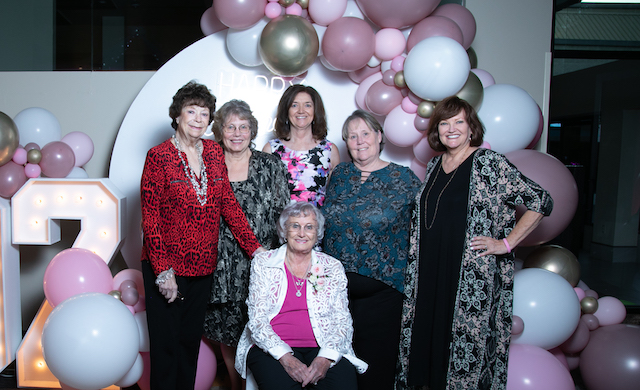
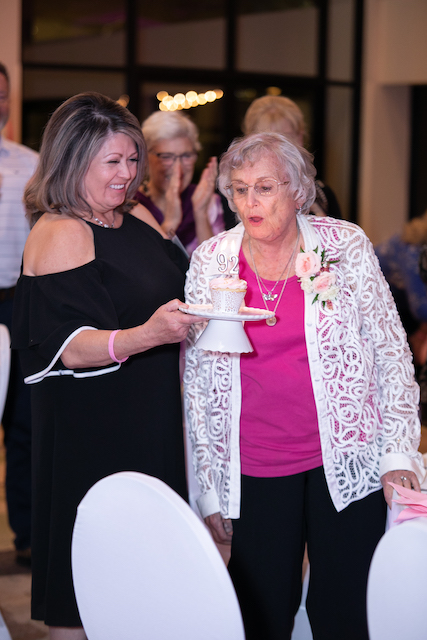
On September 17, 2022, now that the Coronavirus numbers were improved, my friends held the big birthday celebration that they’d been trying to have for me since 2020.  My 92nd birthday party was held at the Hilton DoubleTree in Whittier, California.  Eighty-four friends and relatives helped to make this event one of the highlights of my life.  I wrote the following poem for the occasion:

My 92nd Birthday

It looks like the third time’s a charm

We finally made it here.

What a way to commemorate

My 92nd year!

I’m happy that you’ve come

To help me celebrate.

I think that being 92 

Is really kind of great!

As a nonagenarian, I get to do

Whatever I want to do.

Nothing embarrasses me,

But I might embarrass you!

I say anything I want, and

Don’t always do as I’m told.

People just smile indulgently

And say “It’s okay, ‘cause she’s old.”

I’ll remember this night forever

As I’m basking in its glow.

Let’s all do this again when

I hit the big one-oh-oh!

Lois McKinney

September 2022

Kids Do Say the Darndest Things

By the time I finished my education and was ready to begin teaching kindergarten, I was a married woman with two children, ages 8 and 12.  When the principal asked what my long-term plans were, I told him that this was it and the only reason I’d leave teaching would be if I got pregnant, which didn’t seem likely.  As it turned out, after five years of teaching, my daughter Jeannette came along, and I left the profession.  During the five years, though, I was an audience to some delightful moments with these sweet, imaginative youngsters.  I kept a notebook on my desk in which to write the clever things that came out of the kids’ mouths (my knowledge of shorthand came in handy).  I’m sure there were many clever things said that didn’t make it into my book. These are the ones I recorded.

The first incident didn’t involve the children.  It happened during my very first orientation week.  As I sat in an auditorium listening to welcoming talks, I was cutting out nametags for my kindergarten children.  The gentleman in front of me kept turning around and looking at what I was doing.  I started cursing under my breath, wishing he’d mind his own business.  I was hearing everything that was being said and if I wanted to use the time to get my nametags cut out, that was nobody’s business.  If he didn’t approve, too bad!  Then the gentleman turned around once more and said “Could I cut out some?”     

On my first day as a kindergarten teacher, I was introduced to the vivid imagination of Michael.  He was manipulating a key game and said to me, “Mrs. McKinney, I’ve locked you inside this box.”  I protested, saying, “Michael, I need to watch the children.  Please let me out.”  He responded, “The only way you can get out is if I turn you into a mouse.”  I agreed to this, so, as he waved his hands back and forth in front of my face, he said, in a voice filled with mystery: “You are a mouse.”  As I continued on my way, I felt a presence behind me.  I turned to see Michael stealthily creeping toward me, saying “Meow!”

On the first day of school, Theresa told me that she’d thought she might cry but she didn’t cry and really liked school.  Albert volunteered, in a voice loaded with enthusiasm, “I think school is really ordinary!”  As they left that day, Kevin took his mother’s hand and said, “Good-bye, Mrs. McKinney.  I may see you around school again sometime.”

We were discussing the word “couple.” Matthew volunteered, “Sometimes my Daddy asks Mommy for a couple coffee.”

I asked who knew what a fire drill was.  Randy said, “I know.  It’s what you cook steaks on.”

As soon as she arrived at school, Debbie nudged me and said, “Mrs. McKinney, I have a loose tooth.”  Later, a punch on my side, followed by, “Mrs. McKinney, wanna feel my loose tooth?”  This went on all day.  Then, during a science lesson, we rubbed two rocks together, and the children were telling what they thought we’d see through the magnifying glass.  Grant raised his hand.  I called on him and he said “I think we’ll see sand.”  Michael offered, “I think we’ll see dirt.”  Debbie raised her hand.  I called on her.  “Mrs. McKinney, wanna see my loose tooth?”  The following day – punch, punch.  I apprehensively looked down to see Debbie pointing to a blank space.  “Mrs. McKinney, look – I lost my tooth.”

Less of a chatterbox, one day Mark stated simply, “I got a bendable tooth.”

Gilbert, newly arrived from Cuba, was learning English.  Each morning I would call the roll by saying “good morning” to each child, followed by the child’s name.  Each child would reply, “good morning, Mrs. McKinney.”  Not knowing the language, Gilbert would remain silent when I said “good morning” to him.  I explained that this meant the same as “buenos diaz.”  One morning, Gilbert replied, “good morning, Mrs. McKinney.”  The children were thrilled.  Each morning after that, when I said “good morning, Gilbert,” he’d reply “good morning, Mrs. McKinney.”  Then one day during Activity Period, Michael walked over to him and said, “Good morning, Gilbert.”  Gilbert looked Michael straight in the eye and said, “Good morning, Mrs. McKinney.”  We explained the proper response to Gilbert, and for the rest of the week, our lessons were interrupted by Gilbert’s voice singing out “Good morning, Michael,” “Good morning, Sally,” “Good morning, Tina.”  By year’s end, Gilbert was able to interpret for his parents.

Early in February, I asked if anyone knew whose birthday was next week.  No one knew, so I gave them a hint.  I said, “Honest . . .”  “To God” was Shelley’s suggestion.     

We were exchanging valentines when Randy came to me and said “I don’t deserve valentines.”  I responded, “Of course you deserve them, Randy.”  After he persisted, he was finally successful in conveying his message.  What he meant was that he didn’t observe Valentines Day.  His religion forbade it.  On the other hand, he would often arrive at class holding some small gift for me – a ceramic planter with a plant, a handkerchief, or a cut flower, for example.  This was in keeping with his religion, which wasn’t against the giving of gifts – it was opposed to observing special days. 

Easter was coming so the children were going to make bunnies by pasting various shapes onto a large piece of construction paper.  Before turning them loose on the project, while they watched, I created a bunny on an easel.  After a step-by-step demonstration, my project was complete.   As I looked it over, I said, “I guess I’ll call my bunny done.”  Winston responded with “That’s a funny name for a bunny.”

I made small green paper shamrocks that I pinned onto the children on St. Patrick’s Day so that, as I explained to them, they wouldn’t get pinched for not wearing green.  By the same token, I decided it was my job to educate these children about April Fool’s Day. I used as an example “There’s a spider on your shoulder!”  “Oh, my, where?”  “April Fool!”  There were approximately thirty children in my class so I’d estimate that at least thirty times I was excitedly alerted about a spider on my shoulder.  Actually, the number thirty is probably low because I neglected to account for the serial alerters who weren’t satisfied with only one spider but told me again and again about the ding-blasted spider that I had created.

During a discussion about Thanksgiving, I asked if anyone knew why Pilgrims left their country and came to America.  Michael said, “To eat turkey.”  Later I reminded the children to think of something besides turkey on Thanksgiving.  Suzy said, “Yeah, pumpkin pie!”

Paul showed me a disk of clay that had a design on it.  He said, “I want to keep this.  It’s an emblem.”  Noticing that he had incorporated the initials “ER” into the design, I asked, “What does ER stand for?”  He answered, “How should I know?  I can’t read.”

While we were standing outside, Mark had quite an animated conversation with me, telling about their vacation trip.  When he talked about Smokey the Bear and how awful forest fires are, I inquired as to whether either of his parents smoked, thinking that if they did, I could ask him how he could help them to be careful.  He responded:  “My dad doesn’t smoke cigars; my dad doesn’t smoke cigarettes; my mom doesn’t smoke cigars; my mom doesn’t smoke cigarettes; and Holly – she’s only three – she doesn’t smoke either; and I don’t smoke, too.”

During a parent-teacher conference, I was told that Bobby came home from school one day, very excited because he had a story to tell his parents.   He said, “Mrs. McKinney was really disappointed today.  She had to put a kid in a chair ‘cuz he was bad.”  His mother responded, “Oh, that’s a shame.   Who was the kid?”  At this point, Bobby’s shoulders drooped and he stared at the floor as he muttered “me.”

All the children were sitting, ready for the start of a new school day, when I asked, “Did you all get lots of sleep last night so that you won’t be tired today?”  Pauline responded, “I didn’t need to – know why?  ‘Cause I’m always full of fun and excitement.  I don’t ever get tired – only sometimes my feet get hot.”

The children loved to make up songs, and because I never limited sharing, if a child had nothing to share but wanted to get up in front of the class, he or she might just create a song on the spot.  Carla sang, ”Along came Cinderella, and she fell over a barrel and she fell in the water and a shark ate her and she was scared and her mommy missed her.”  And then there was Randy.  He was the king of made-up songs.  I could almost see the wheels grinding in his head as he’d look around the room and incorporate whatever he saw into the lyrics.  I shared this with my family, so now any time we hear a song that rambles and hasn’t much of a tune, we call it a “Randy song.”

During a duck-and-cover alert, after they’d been under the tables for a while, Mark asked, “Where’s Mrs. McKinney?”  Pauline said, “I know!  She’s over there, hiding inside of her dress.”

Robert proudly announced that he was learning to spell, saying “Y-e-s, yes; Hell no, no.”

While discussing a movie we’d seen about the harbor, I asked if anyone could tell me what “gangway” meant.  Walter said, “Come on, people, let’s go do something.”

I told the children to sit down.  Pauline asked, “What are we going to do?”  I responded, “We’re going to take a walk as soon as everyone sits down.”  Quite earnestly, Pauline asked, “How can we take a walk with everyone sitting down?”

I was reading a book to the class.  There was a picture of a tiger tearing the seat out of a man’s pants.  Claire said, “Turn the page and see if he’s wearing red polka-dot underwear.  They always are!”

Alan shared the following: “Well, I’m the real batman from now on – well, not all the time, but when batman is sick, I take over.”  I asked “When did all this happen?”  “Last night they came to my house and told me.”

I pitted boys against girls in a game of “Johnny Jump-Up,” using the tally method of score-keeping.  The girls had four strokes; the boys, none.  The girls got another point, so I put a diagonal line across the first four strokes.  Bruce heaved a sigh of relief and said, “Good, she crossed them all out!”

When I asked David to go next door to borrow a paper punch, he queried “Paper punch – what’s that?  Maybe you drink paper.”

From turning the teacher into a mouse to being able to drink paper, while teaching kindergarten I learned that kids really do say the darndest things.  I also found a lot of insightful, clever, and funny things said by children outside of my kindergarten classroom.

Jeannette was born after I taught kindergarten, so I’d learned to write down the cute things she said.  Recently, I took all the scraps of paper on which I’d written these notes, making a list of Jeannette’s cute utterances.

When she had just learned to talk, instead of “heavy,” Jeannette would say “heddy.”  When asked to do something that she thought was too difficult for her, she’d say “too heddy.”  To this day, the family refers to extremely difficult tasks as “too heddy.”

When she was four, I recorded several cute or clever things said by Jeannette, including the following:

“When my father goes to work, I have to get in bed with you because two people need to be in your bed because we love each other.”

“Do you stand by my bed at night and watch me grow?”

“My dress is too long. You should stem it.”

With arms outstretched, Jeannette said,  “I love you this much.  You love me more because you have longer arms.”

When Jeannette was five, she said:

“Your eyes don’t look like you can see through them.  They just look like a decoration on your face.”

“When I’m holding a pickle and I’m going to try it, sometimes my mouth gets sort of worried.”

While we folded clothes, Jeannette said, “Remember when I was little and I thought I was folding them but I just crumbled them?  You said, ‘Honey, see how I’m folding’.  You kept and kept and kept showing me how but I kept crumbling them.  That’s the way it goes.  Little kids can’t understand.”

In talking about her grandfather she never knew, Jeannette asked if she was in my tummy then:   “I was melting away just like nothing – just like if we didn’t have any furniture or anything to sit on or anything.”

At age six, Jeannette said, “When ladies get married to men, they snootch all the time.”

While watching television, Jeannette said, “How do they get those horses to walk in such a straight line?  They must be girls to learn so easily.”  

Any time we needed to use a restroom while traveling, I’d admonish my kids not to touch anything other than necessary, explaining that this was a public restroom.  Consequently, when Jeannette’s first-grade teacher asked if anyone knew the meaning of the word “public,” Jeannette said it meant “dirty.”

When she was six, Jeannette said:  “I got a whole bunch of sow bugs.  Is it okay if I keep them?”  I responded with a question:  “What are you going to do with them?”  “Oh, teach them tricks.  I already taught one a trick.”  When I asked what, she said, “To stand on his behind legs.”

The first time Jeannette experienced kelp while swimming in the lake, she became frightened.  I explained that it was seaweed and was harmless.  After that, when she spotted kelp, she’d say, ”Pee-wee won’t hurt me – huh, Mommy?”

Many years before Jeannette was born, our son Lynn came up with his own expressions.  At the age of two, he had words for his three favorite things:  oil wells, powder, and Safeway stores.  When he saw an oil well, he’d say over and over and very fast:  “See wow-wow, see wow-wow!”  I don’t know why he had a fascination with powder.  I believe he watched his grandmother apply it to her face, and asked her what it was called.  He’d say rapidly “See pow-doo, see pow-doo!”  He recognized Safeway stores by the yellow and black tile fronts they had at that time.  When we passed one, he’d say “See Way-way, see Way-way!” over and over until the store was out of sight.  When we took a cross-country trip, we were reminded again and again that there were Safeway stores in many states.

As is true with most little boys, Lynn got really excited when he saw a fire engine, which he called an “enger-funjer.”

When he was a little older, as we were driving, Lynn would point and say, “Mommy, who made that tree?”  I’d respond,  “You know who made the tree,” whereupon he’d say, “God made the tree.”  Or “Mommy, who made the sun?”  “You know who made the sun.”  “God made the sun.”  Then one day when we passed an excavation project with a mound of dirt, Lynn asked, “Mommy, who made that big pile of dirt – God or the tractor man?”

Lynn coined a word that I found to be quite appropriate.  I really believe it should be added to the dictionary.  That word is “lasterday.”

When I was studying to become a teacher, Lynn asked what grade I planned to teach.  When I told him I wasn’t sure, he said, “Whatever you do – don’t teach fifth grade.  Fifth graders are monsters!”  I said, “Lynn, you were a fifth grader last year,” and his response was “Yeah, and remember what a monster I was.”

When Lynn was in middle school, he was the victim of a trouble-maker who told him that Robbie wanted to fight him, while telling Robbie that Lynn wanted to fight him.  Lynn later told me that he’d had no intention of fighting, but when Robbie grabbed him by the collar of his beloved Pendleton jacket, Lynn saw red and a battle ensued.  Lynn punched Robbie in the mouth and seriously cut up his knuckles, requiring a trip to the emergency room.  When he was moaning in pain, I asked if he’d learned his lesson.  He said he had.  “And what is that lesson?”  “When you punch someone, don’t punch him in the teeth.”

We were in the car with Lynn and his friend Steve in the back seat.   Suddenly, Lynn said, “Steve, know what?”  When Steve asked “What?” Lynn said “Watermelon.”  A little later Lynn said “Steve, know what?”  Steve replied “What?” and Lynn said “Watermelon.”  Again, a little later, “Steve, know what?”  Steve said, “Yeah, I know what – watermelon.”  Lynn said “No, cantaloupe.” 

When she was quite small, our daughter Michelle was good at creating her own expressions.  Once while riding in the car in the rain, she said, “The tick-tocks make the windows clean, don’t they, Daddy?”  She left the crust when she ate a sandwich, stating that she didn’t like “sandwich skin,” and when she was thirsty, she said her mouth was melting.

When Michelle’s big brother Lynn caught a grasshopper and asked for a container in which to put it, I gave him a coffee can.  Each time she looked at the can, Michelle excitedly said, “Gaspopper.”  One day at a market there was a display of cans of coffee, and Michelle could hardly contain herself because she was so excited to see so many gaspoppers.  That wasn’t the only time she had people staring at her in public.  She spoke in complete sentences at an early age, and people would turn and stare, thinking, “Did that come out of that tiny person?”

At the age of four, Michelle said to me, “Do you know why the streets are clean in the middle?  Because the cars make wind that blows the dirt off the middle of the street.  That’s why the street cleaner just goes along the edge.

When Michelle was in first grade, she came home from school and said, “Help me write ‘My father is a butcher,’ and I’ll read it for you.”  I said, “No, I’ll help you write ‘My father is a coach’.”  Michelle said, “You don’t understand.  I want to show you how I can read.  I know my father is a coach.” 

Another time Michelle said “Karen, Debbie, and I are the best workers in the class.”  I asked her if her teacher had said that.  She responded, “No, the teacher said Karen and Debbie are the best workers – but I’m a good worker, too.”

When Michelle was learning to water-ski, we asked her if she was ready for a lesson.  She replied, “No, there are too many white cats.”

When she was around seven, during a trip to Mexico, Michelle was fascinated with the language, and before long she said to us, “I can speak Spanish – ‘Goleta-golota’.”  From then on, Michelle regularly displayed her knowledge of Spanish by repeating her own original phrase:  “Goleta-golota.”  She never shared its meaning with us.

Before she was a year old, my granddaughter Laura lived across the yard from a baby also named Laura, who was the same age. Whenever my granddaughter saw neighbor Laura, she would excitedly say, “Ba-ba, Ba-ba.”  One day, while in a grocery store, Laura started pointing and saying, “Ba-ba, Ba-ba! and there was neighbor Laura pointing and yelling, “Ba-ba, Ba-ba!” Laura’s parents looked at neighbor Laura’s mother and she looked at them, and they all were thinking: “Wow!  She calls Laura Ba-ba, too!”  From then on, both baby Lauras were “Ba-ba” when they were together. 

When she got a little older, Laura had her own words for her favorite foods:  yogurt was “yorgut”; spaghetti was “gabobbi”; and zuchinni was “kamimi.”

 Grandson Matt’s language began with one word, “dah-deesh,” that he used for just about everything, which reminded me of his father, who also had a one-word vocabulary at that age, which I interpreted as “tah-deesh,” but may have actually been the same pronunciation.  Fathers often pass traits on to their sons, but I find it unique that Lynn passed on this unusual first word. 

As he got a little older, Matt had some sophisticated expressions. One began with “Well, actally, …” and then there was, “In a manner in fact,….” 

Once when Matt was sitting in his high chair in his grandmother’s kitchen, watching the rain outside, his mother mentioned that his voice was kind of high.  Right then, he said in a deep baritone, “Look at da rain.”

When granddaughter Sara was around two or three years old, if someone teased her or said something she didn’t like, she’d point her finger at the offending person while saying, in a menacing voice, “Don’t!”

My granddaughter Kassie showed dogs with her grandmother.  When she was two years old, the judge asked to see the dog’s bite.  In her most authoritarian voice, she stated, “My dog doesn’t bite.” 

Kassie was good at math.  When she was about five years old, one day when we were going to an event and she asked what time we were leaving, I said “It’s 4:30 now and we’re leaving in 45 minutes.  What time will that be?”  She responded: “I need a piece of paper to write it down because then I could always get the answer almost probably.”

After hearing her mother call me by my name, Lois, my granddaughter Laura immediately started calling me “Grandma Belois.”  She was the only one to calm that, though.  To most of my grandchildren and great grandchildren, I’m “Maw-Gaw,” which is the name given to me by granddaughter Kassie when she was beginning to talk.  I considered that unique until my niece Terry brought her grandchildren to visit.  They had also dubbed their grandmother “Maw-Gaw.”

Another name for a grandmother occurred while my grandson Matt was visiting his mother with his son.  “Who’s that, Joey?” Matt asked.  Knowing that there was another woman he called “Grandma,” after thinking about it, little Joey said “Buggum,” and it stuck! 

To great-granddaughter Hailey, a lawn mower was a “mow-lawn” and a finger was a “thinger,” which seems appropriate when using a finger to point at some thing.

My two great-grandchildren, cousins Hailey and Joey, were sitting close together on the couch, deep in conversation. Everyone else in the room stopped to listen, and heard Joey say, “It was vewy funny, but vewy inappwopwiate!”

On his fourth birthday, Jaden, totally engrossed in practicing hitting the ball off his new tee, was heard to say, in a deep “Dad’s” voice, “Ya hafta bend your knees.”

When great-granddaughter Sara was small, if she didn’t care for something, her method of communication was to say the word “like” while vigorously shaking her head back and forth as if to say “no.”

Again, relying on one word to convey her message, being an independent little tyke, Sara would say “self” when people offered assistance that she didn’t want – her way of saying “I’ll do it myself.”

My great-grandson Daxon came up with a very perceptive observation when he pointed out that it is the reckless drivers who have the most wrecks.

My great-granddaughter Maelle was doing an experiment in which she made certain things float.  Her mother said,” Wow, it’s magic!”  Maelle said, “It’s not magic – it’s science.”  She has said this many times since, when we marvel at things that seem special.  In fact, “It’s not magic – it’s science” has become a part of our family’s lexicon. 

While putting up Christmas decorations, when she was five, after taking ornaments from two layers of a five-layer box, when my great-granddaughter Natalie saw another layer, she said, “Oh my gosh, this is going to take forever!  I need a drink.”

When Natalie asked her mother to get down cornstarch and food coloring, saying she was doing an experiment to make slime, her mother reminded her:  “You need an adult.”  In her “well, duh” voice, Natalie said, “You are the adult.” 

Natalie spilled some water while watching a movie.  When asked to pick it up, she responded, “I’m picking it up with my mind.”

During Art Linkletter’s heyday, we were watching him interview a little girl.  Art said to her, “Let’s pretend you’re Cinderella’s wicked step-sister.  Wicked step-sister, why are you so wicked?”  The little girl wrinkled her brow, thought for a minute, and then said in a gruff voice, “Because I wike to!”  That really stuck with my family.  When a family member is asked why he or she did something, the answer is very likely to be “because I wike to!” 

I’m sure I’ve heard many more adorable and thought-provoking expressions from the mouths of children, but can’t think of them now.  I’ll consider this a work in progress and will add more when I remember them or hear new ones.  If you asked me why I record all of these fascinating stories, my answer would be “Because I wike to!”  And Art, you were right – kids do say the darndest things!

                                                                                                                                                                                                                                                                                                                                          Lois McKinney

August 2022

What’s In A Name?

My Grandson and I

Sometime in late 2015, my grandson Jacob and his wife Rebecca announced that they were expecting their first baby, a girl. They had selected a name but were keeping it secret. They had plans to have her name on her bedroom wall in large letters. I was given one of those letters to decorate – a “T.”

I began referring to the forthcoming baby as “Tabitha.” Several weeks before the baby was born, in the middle of the night I suddenly sat up in bed and uttered the word “Natalie.” The next morning I texted this event to Jake. His response: “What about Tabitha?”

On June 14, 2016, my grandson telephoned me to tell me that my great granddaughter had been born. He said, “You were right, Grandma; her name is Natalie.” Jacob’s wife Rebecca announced to family and friends that Great Grandma Lois had figured out the name. I explained that I hadn’t figured out anything. It came to me. This was a case of ESP – Jacob had obviously shot thought waves all the way from Texas to California.

Over five years later, in October 2021, Jacob and Rebecca announced that they were expecting their second baby, another girl. Again, they didn’t reveal the name that they had selected. Again, they planned to put their little girl’s name on her bedroom wall, and again, I was given the letter “T” to decorate; Grandma Mish and Grandpa Bobba were given the letter “E.”

Knowing that Michelle, her daughter, a friend, and I play Wordle each day, Bob suggested that we play Wordle to determine the baby’s name, so I created an informal Wordle game. As with the New York Times Wordle, the name was limited to five letters. I chose the name “Katey.” Michelle, Sara, and Chris would each give me a guess privately and I’d let each of them know when they had correct letters and when the letters were in the right place. Their guesses were Emily, Kerry, Kacey, Natey, Janey, Sadie, Mabel, Haley, Tilly, Stacy, Kaley, and Kathy. I was sure that the name hadn’t been guessed – in fact, chances were pretty good that the name selected for the baby wasn’t five letters – but I sent all of the names that were guessed to Jacob, telling him that his Dad had suggested a Wordle game and these were the results.

I continued to think of names, but didn’t really pursue the subject.

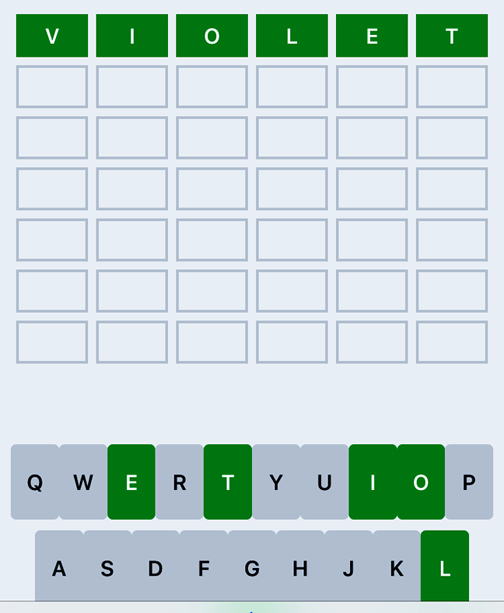
On the day the baby arrived, April 14, 2022, Jacob sent us a very sophisticated Wordle game that he had created, which would reveal the new baby girl’s name. According to the game, the name consisted of six letters, and I knew it contained a T and an E. When I looked at the Wordle, the first name that came to mind was “Violet,” a name I hadn’t even considered before. Michelle and I both excitedly began our puzzles. After I entered “Violet,” all six letters turned green. I GOT THE NAME ON THE VERY FIRST TRY! When I told Michelle of my good luck, she was so eager to know the name that she didn’t even finish the puzzle but came running over to view it on my phone.

What could have caused me to select this name? It’s clearly another case of ESP. Jacob had again shot thought waves, this time from Texas to Oregon. Obviously, my grandson and I have an extra-sensory connection. There’s no other explanation.

Lois McKinney
April 19, 2022

Not Just Another Monday!

On Monday, March 7, 2022, I left my Zoom Writers’ Group meeting and got into the car to be driven to my cardiologist appointment. In October, because of a heart irregularity, I was having breathing problems, so my daughter Michelle called 911. After the EMT found I was in atrial fibrillation and my heartbeat was 160, I was off to the hospital. There, a heart echo revealed that I had an ejection fraction of 10-15%. I didn’t know anything about ejection fractions, but was told by the hospital cardiologist that he had never heard of a conscious person having an ejection fraction that low, the normal range being 50-75%.

After receiving excellent care, including cardioversion to get me out of atrial fibrillation, I breathed better and we were sure that my ejection fraction had vastly improved. Four months after my first heart echo, cardiologist Dr. Virgilio ordered a second echo, which was performed. An appointment was made to go over the results, and that was the reason for the March 7th visit.

Dr. Virgilio discussed the results of the latest echo, which showed an ejection fraction of 45%, close to normal. After asking me a series of questions, she was pleased that I was feeling good and back to normal activities and routines. After listening to my heart and noting a heart rate of 40 beats per minute, she ordered an EKG (electrocardiogram) which revealed a sinus arrest with a slow ventricular rhythm. Dr. Virgilio was very concerned and said I needed to go to the hospital at once to get a pacemaker. She explained that I was suffering from heart block, and because my natural pacemaker had stopped doing its job, I needed a new one. After checking, she advised us that the cardiologist who performs pacemaker implantations was on vacation, so I would need to go to a hospital near Eugene, an hour and fifteen minutes away, for the procedure. She arranged for me to be under the care of a cardiologist at that hospital. Then she added that because I take Eliquis, a blood thinner, I’d need to wait 48 hours before the operation. Stating that my situation was precarious, Dr. Virgilio insisted that I couldn’t spend those two days at home, but needed to be in the hospital where I could be closely monitored.

Michelle drove me to the PeaceHealth Sacred Heart Medical Center in Springfield. We arrived there around 6:45 PM. I was admitted into the E.R., awaiting a hospital room. I was put on a monitor that revealed that my heart rate averaged 35 beats per minute, a far cry from the 160 beats per minute that I had experienced when I went to the hospital in October (the normal range is 60-100). In addition to the heart monitor, I had a 12-lead EKG, got a chest X-ray, and blood was drawn for testing. External pacemaker pads were placed on my chest and back to be used in case temporary pacing was urgently needed. At two minutes after midnight on Tuesday, March 8th, I was moved from the E.R. to a hospital room.

When I awoke at 3:00 AM Tuesday after a short sleep, I was hungry, having had only a light dinner before coming to the hospital. When I requested food, I was advised that doctor’s orders called for fasting, which made no sense when the surgery wouldn’t be until the following day.

Later in the morning the cardiologist who was to implant the pacemaker, Dr. Karenem, came into my room and advised me that he would perform the surgery on this day. When I inquired about the 48-hour wait because of the blood thinner, he told me that the danger of bleeding was less than the danger of waiting. Then Dr. Karenem explained exactly what would be done, in terms I could understand. Before our discussion began, I called my daughter, Michelle, and put her on speakerphone so that she could be a part of the conversation and, based on her knowledge as a former Cardiac Intensive Care nurse, could explain anything that wasn’t clear to me. I was also shown a pacemaker so that I’d know what I would be wearing (what alien being would be inhabiting my body).

For the surgery, I was given a sedative and a local anesthetic, so I was awake but groggy. I marvel at what a wonderful invention the pacemaker is and the amount of skill it must take to be able to string wires through veins to the atrial and ventricular chambers of the heart. The surgery took a little over an hour.

After the post-procedure chest x-ray, I was delighted to learn that I could go home – the same day as my surgery! I didn’t need any time to decide. Funny thing, after I was admitted, I was asked to sign a form stating that I had been told I could decline leaving when a doctor cleared me to go home. This was a new Medicare requirement. I was incredulous to think that anyone would want to stay in the hospital when allowed to go home. In thinking about it now, I remember cases when patients were released and reluctantly left before they were ready and became dangerously ill.

On the way home, Michelle asked if I wanted to stop to see my granddaughter’s new home in Springfield. I was tired but didn’t want to miss this opportunity and, after all, I could do lots of resting when I got home, which is exactly what I did.

Shortly after returning home, I experienced a side effect from the agent that was used to cleanse the area prior to surgery. I developed a rash and the area itched, keeping me awake several nights. So it appears that there is yet another substance that I have difficulty tolerating.

On Wednesday, the day following my surgery, I accompanied Michelle when she was walking Banjo. After going just a short distance, Michelle noticed that I was shuffling instead of picking up my feet, so she suggested that it was time to turn around and go back home. We did this and, although it was a really short walk, I was exhausted. I grumbled a bit because of my incapacity to walk farther, and was reminded that I was expecting too much too soon. Two days later, I was capable of walking farther without getting winded.

Now that I’m healed, I have more stamina and my life is back to normal. It’s strange that the two times in the last six months when I’ve been in danger because of my heart, I felt generally good and had to be told that my situation was precarious by medical professionals, who then proceeded to get me out of those precarious situations. God bless medical professionals!

Lois McKinney
May 2022